

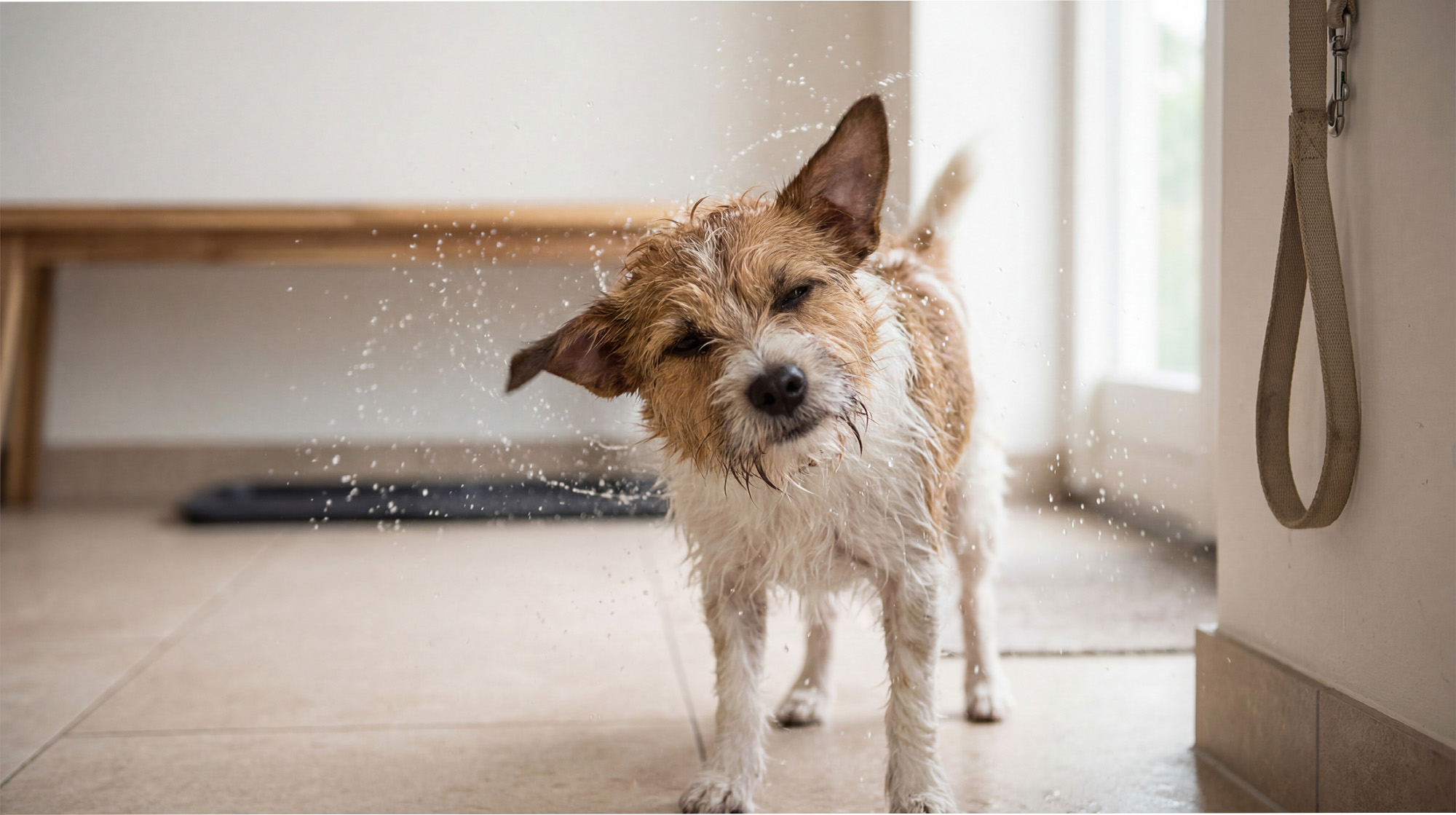
Dogs Grip With Their Nails And That Backfires Indoors
Outdoors, a dog's nails work like cleats. They dig into grass, soil and loose ground, and the pads follow behind for cushioning. It is an efficient system that evolved for exactly those surfaces, and it is the reason a dog can take a corner at speed across a lawn without a second thought.
On tile, the nails cannot penetrate anything. Instead of biting in, they hit a hard surface and act as tiny stilts, lifting the soft grippy pad slightly off the floor. The longer the nail, the more the pad is held clear of the surface it is meant to be gripping. This is the detail that surprises most owners, because the instinct is to assume more nail means more traction. Indoors it is the reverse.
Why Age Changes The Picture
A young dog slips and catches itself so quickly you barely register it happened. Correcting a slip takes rear end strength, quick reflexes and good proprioception, which is the body's sense of where its limbs are. All three soften with age, and arthritis or hip changes reduce the confidence to push off firmly in the first place.
What often follows is behavioural rather than physical. A dog that has slipped badly once or twice starts avoiding the room where it happened. Owners notice their dog hesitating at the edge of the kitchen, taking the long way round, or refusing to cross an open tiled space entirely. That avoidance is usually the first sign something has changed, and it tends to appear before anyone connects it to the floor.
The Two Cheapest Fixes Come Before Any Flooring Decision
Nail length is the single biggest variable you control, and it costs nothing but a regular trim. Shorter nails let the pad make proper contact with the floor. Alongside that, the fur that grows between the pads on many breeds mats down over the gripping surface and acts like a slipper. Trimming it back flush with the pads restores a surprising amount of grip on its own.
After that, think about the route rather than the room. Dogs travel the same paths through a house every day, usually between a bed, a water bowl and a door. Runners and rugs placed along that specific path do far more than a large rug positioned where it looks best. Wet paws deserve attention too, because water on tile cuts grip sharply, which is why entryways and the area around a water bowl are such common slip spots. A towel by the back door genuinely helps. Toe grips, paw wax and indoor booties work well for some dogs and not others, so they are worth trying rather than counting on, and any dog that has started slipping noticeably is worth a vet check for joint changes.
What To Look For If You Are Choosing A New Floor
Slip resistance is measurable rather than a matter of opinion. The figure to ask about is the dynamic coefficient of friction, usually shortened to DCOF, which manufacturers publish for most residential tile lines. Higher numbers mean more grip, and a rating of 0.42 or above is the general benchmark for interior floors likely to be walked on while wet. Textured and matte finishes typically test higher than polished ones.
Here is the part that rarely gets mentioned. Grout lines provide traction, and more of them means more grip per square metre. That makes a smaller tile format genuinely better for a dog than a very large format one, which is the opposite of the current design trend towards fewer visible joints. It is a real trade off worth weighing, because textured surfaces and more grout lines also hold dirt a little more readily. Neither consideration makes one choice wrong. It depends whose comfort is driving the decision.
Tile Is Still A Sensible Floor For A Dog Household
None of this is an argument against tile. For homes with animals it handles accidents, muddy paws, dropped water bowls and claw contact better than almost anything else, and it cleans up in a way soft flooring simply cannot match. The traction issue is real but it is solvable, and it is solved mostly through finish selection and a few small habits rather than by ruling the material out.
Hardwood has its own considerations in a dog household, with nail marks on softer species being the usual one, and it suits plenty of homes very well. The useful approach is to be honest about which rooms your dog actually lives in, and choose for those rooms specifically rather than applying one answer across the whole house.
At Dungan's Floors, we are happy to talk through finish, texture and format with your animals in mind, including pulling DCOF figures for anything you are considering. Have a look at our tile range and we will help you narrow it down for the rooms that matter most. We serve homeowners throughout Mckinney, TX, Allen, TX, Plano, TX, Princeton, TX, Prosper, TX, and Celina, TX from our showrooms at McKinney, TX. Contact us to find a floor that works for everyone in the house.


